


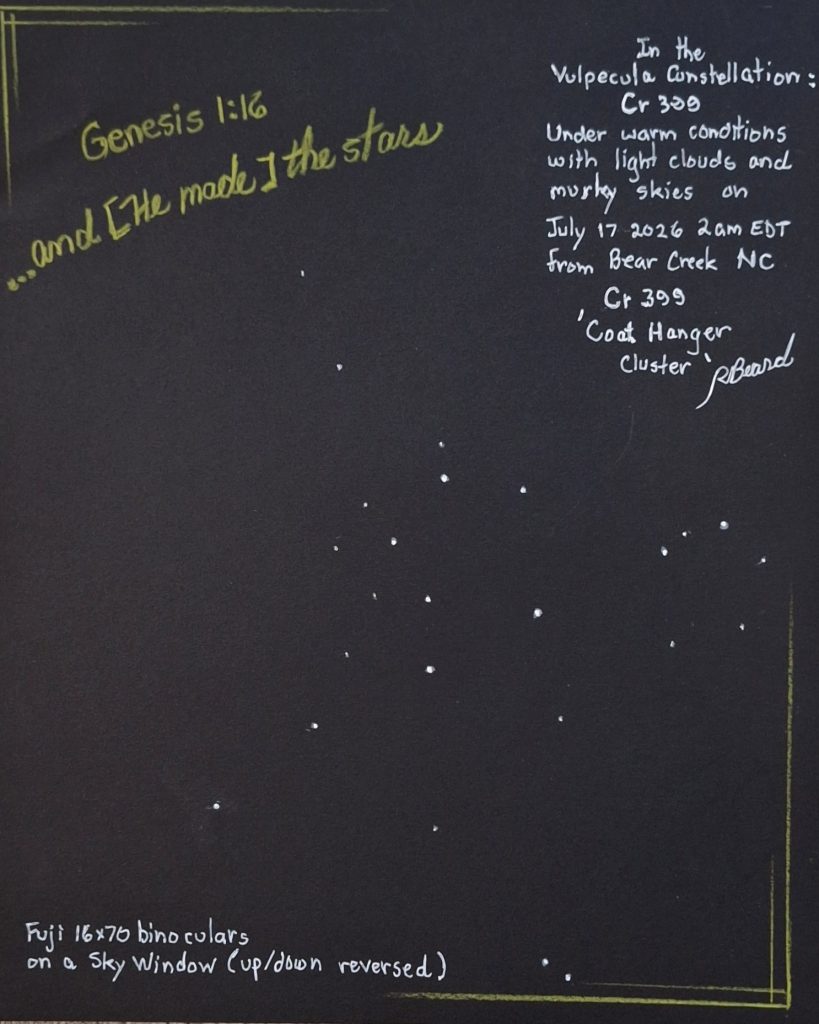
 The late summer evening was clear enough so the Milky Way could be easily seen. Looking at the Cygnus constellation overhead is always a favorite, but my time was short to review some objects. So, I used a binocular arrangement with a reflecting mirror that is quick to set up. In five minutes, I was comfortably traveling around the ‘tail’ of the Northern Cross (the common name for Cygnus) and found the Coat Hanger Cluster. While the star field is really busy nearby, this pattern of stars (called an asterism) lies in a quieter area. When you see it, the hanger shape jumps out. The sketch shows you a 15-minute rendering of the object.
Moving forward a couple months, my wife and I visited Sandhills Horticultural Gardens in Southern Pines, NC. The Autumn weather was perfect as we meandered through the gardens and finally went in the lowest area that empties water into a nearby pond. The colors were beautiful and the surrounding lowlands were, as well.
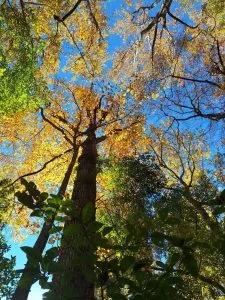 At one point, because of my training in night observations, I looked up to catch a startling view of tall trees in golden splendor against the blue sky. It was mesmerizing.
Here is the parable: most people do not naturally look up, whether it be by day or night. But look what is missed! It only takes a desire and some training to be more observant to begin to find treasures that are already present but often not seen. It’s the same way with the Kingdom of God. Without a desire to find the God of Creation, which means looking beyond what is customary, very few find Him. But with a desire to find Him, one finds He is right there. That is the point Paul makes when he speaks to the Athenians in Acts 17 (a New Testament book of the Bible). Paul explains to his audience God is not unknown and can be found, if they would seek Him. He goes further to explain who He is.,
Reference: Acts 17:22-31
*******************************************
 Technical note on the equipment used for the night observation:
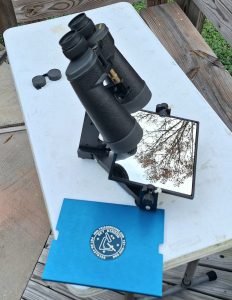
The 16×70 Fuji binocular that was used for the night observation is mounted on a desk tripod with a quality mirror that can be rotated forward or back. So, with a tiny bit of effort while sitting with my head looking down at a comfortable angle, I can go from zenith to the horizon to examine almost 6 degrees of angle of the sky, or I can change the tripod in azimuth. It takes 3-4 minutes to set up, and it can be positioned on a table with a sketch pad and pencils for sketching. Because a mirror is used, up and down are reversed, but most sky observers have optics that flip the image once or twice, so it is not a strange thing.
